

Firstly, if you want success as a web application security analyst, you need to stay up to date with this dynamic category of Cybersecurity. I would recommend doing this socially whenever available, and some ways to do just that are:
Becoming an OWASP (Open Web Application Security Project) member:
Attending your local OWASP chapter meeting. These meetings are sometimes held remotely.

Following some inspirational professionals with skills in web application security is extremely rewarding such as Rana Kahlil and Nahmesec has a fantastic Udemy course in bug bounty hunting and web application hacking and or Jason Haddix produces The Bug Hunter’s Methodology Live Course set this June 2024 for aspiring bug hunters.*
All three of the above mentioned as extraordinary pentesters. Rana Kahlil operates the Rana Khalil Academy that will benefit anyone using the Burpsuite proxy.
Nahmesec and Jason Haddix have discussed methodology and performed web application pen testing on YouTube for our benefit as well.
https://www.youtube.com/@NahamSec
https://www.youtube.com/@jhaddix
https://www.youtube.com/c/ranakhalil101
That is not to say, “disregard other ethical hacking channels.” I just find the three mentioned to be sound professionals in this space.

I am done mentioning the amazing social resources you have to allow yourself to learn and hone web application security skills; now, I want you to be aware of what this role must be cognizant of, such as understanding common vulnerabilities and exploits, security tools, and technologies, as well as having a grasp of scripting and coding languages used in building web applications. Being stronger in one of those mentioned and not the other should not deter your motivation to be a web application security analyst. In fact, it should be the fuel that allows you to propel yourself into research and certification pursuit to build that strength and be better equipped to perform well as a web app sec analyst.
When conducting a web application security assessment for the first time, it will serve you well to combine the rudimentary with the extraordinary. Using a checklist created for bug hunters can be very beneficial to your mission. This checklist should be as extensive as possible and allow you to fall down every single hole that was dug before you through the aid of socially delivered content. You should remain curious and bold in your pursuits as you are a part of the organization’s immune system without your toil and remediation. A bad actor may become aware of an exploit and use it maliciously. I will supply you with something I came across socially, as in cybersecurity, it is in our best interest to share knowledge and be transparent. I may not be able to supply a link to this content, but I am in no way trying to pass it off as my own. With no author credited, we can only stand to reason that this is shared for the benefit of all those who would use it.
This checklist should look like the following:
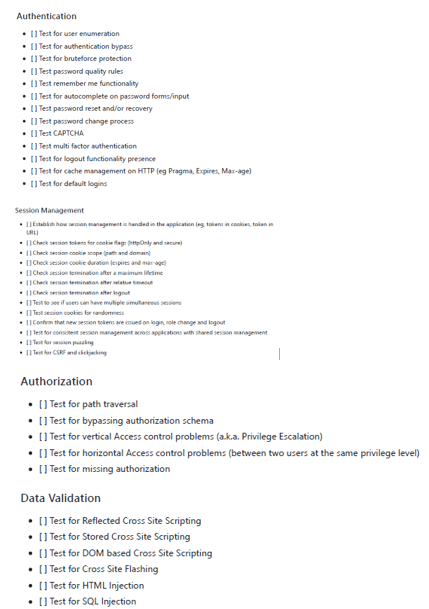
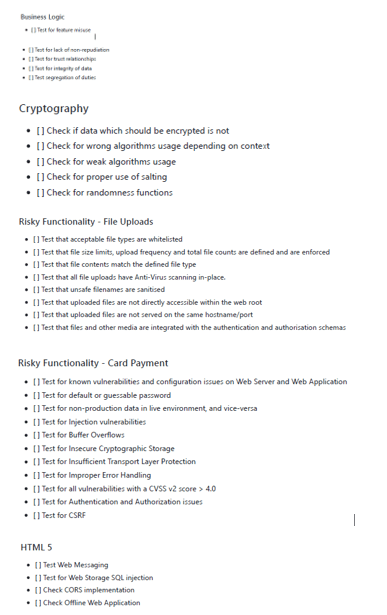
This checklist was made using OWASP’s online resources. OWASP is a significant component of the arsenal of a web app security analyst and should be held in high esteem as it creates the standards and best practices for web application professionals to use to achieve compliance in many industries. OWASP has achieved this by being a community-based project that consists of international professionals, developers, and enthusiasts. OWASP aims to equip web application security analysts with a list of the top ten vulnerabilities, security tools, guidelines, and educational material. This is all powered by professionals who are motivated and passionate about security. OWASP is a vital and sacred part of being a web application security analyst, and it should be analyzed often.
Understanding OWASP is essential for your tasks in web app sec. The OWASP Top Ten is an updated list of vulnerabilities for you to examine and use while conducting audits, and it is worth mentioning that just because the OWASP Top Ten does not list a vulnerability does not make it any less important for you to experiment with in your audits. The OWASP Top Ten is a list of vulnerabilities that are perceived to be of the most risk. Not a list of all vulnerabilities that are able to be exploited.
The OWASP Top Ten Web Application list can be found at the following URL:
https://owasp.org/www-project-top-ten/
As a Web Security Application Analyst the need to understand web technologies such as the below are essential:
HTML
- CSS
- JavaScript
- HTTP/HTTPS
- Web Servers and Databases
I will briefly explain what makes them essential for a web sec app professional.
HTML – Understanding HTML is crucial for a Web Application Security Analyst because it enables them to identify and analyze vulnerabilities like Cross-Site Scripting (XSS) and form manipulation by reviewing source code and understanding web page structures. It helps them grasp basic web functionality, client-side vulnerabilities, and how browsers render content. Knowledge of HTML is essential for creating and using effective security tools, performing manual security tests, and communicating effectively with developers to provide actionable security recommendations. Additionally, it allows analysts to contribute to building secure web applications by ensuring proper input validation and output sanitization.
CSS – Knowing CSS (Cascading Style Sheets) is essential for a Web Application Security Analyst because it helps in understanding how web pages are rendered and manipulated. This knowledge is crucial for identifying and mitigating security vulnerabilities related to the presentation layer of web applications. For example, attackers might use CSS to obscure malicious content or manipulate the appearance of elements to trick users into performing unintended actions (like clicking on a hidden link). Understanding CSS allows analysts to better detect and analyze such tactics, ensuring that they can effectively secure the entire web application.
JavaScript – Knowing JavaScript is crucial for a Web Application Security Analyst because it is a fundamental part of modern web applications, often used to enhance user experience and functionality. JavaScript can introduce security risks, such as Cross-Site Scripting (XSS) and Cross-Site Request Forgery (CSRF), which can be exploited if not properly managed. Understanding JavaScript allows analysts to identify and mitigate these vulnerabilities effectively. Additionally, knowledge of JavaScript enables analysts to understand client-side behaviors, manipulate and test scripts for vulnerabilities, and develop secure coding practices. Mastery of JavaScript is essential for performing thorough security assessments and ensuring robust application security.
HTTP/HTTPS – Understanding HTTP/HTTPS is crucial for a Web Application Security Analyst because these protocols underpin all web communications. HTTP (Hypertext Transfer Protocol) is the foundation of data exchange on the web, defining how messages are formatted and transmitted, and how web servers and browsers should respond to various commands. HTTPS (HTTP Secure) adds a layer of security by encrypting data using SSL/TLS, ensuring the confidentiality and integrity of data in transit. Knowledge of these protocols allows analysts to identify and mitigate security vulnerabilities, such as man-in-the-middle attacks, insecure data transmission, and misconfigurations in server responses. This understanding is essential for securing web applications and protecting sensitive user information.
Web Servers and Databases – Understanding web servers and databases is crucial for a Web Application Security Analyst because these components form the backbone of web applications. Knowledge of web server configurations, such as Apache or Nginx, helps in identifying and mitigating potential security misconfigurations and vulnerabilities like directory traversal and insecure headers. Similarly, understanding database management systems (DBMS) such as MySQL or PostgreSQL is essential to safeguard against SQL injection attacks, improper data handling, and unauthorized access. This knowledge allows analysts to ensure secure data storage, manage permissions, and implement robust security controls, thereby protecting the application from a wide range of security threats.

As a professional knowing the tools you will use will be another essential part of this job role some of which are:
- OWASP ZAP
- Burp Suite
- Nessus
These are briefly gone over just below:
OWASP ZAP (Zed Attack Proxy) – is an open-source web application security scanner that helps identify vulnerabilities in web applications. It acts as a proxy server and intercepts web traffic between the browser and the web application. By doing so, it allows analysts to manually explore the application while automatically scanning for common security issues such as SQL injection, cross-site scripting (XSS), and more. OWASP ZAP is crucial for a Web Application Security Analyst as it provides comprehensive tools for testing and finding vulnerabilities in web applications.
Burp Suite – is a widely-used platform for performing security testing of web applications. It includes a variety of tools such as a proxy, scanner, intruder, and repeater, which help in identifying and exploiting vulnerabilities. Analysts use Burp Suite to intercept, modify, and analyze HTTP/HTTPS traffic between the browser and the web server. This tool is essential for manual penetration testing and automated vulnerability scanning, making it a versatile asset for detecting and addressing security weaknesses in web applications.
Nessus – is a vulnerability assessment tool that scans for vulnerabilities, misconfigurations, and compliance issues across various systems, including web applications. It is capable of identifying a wide range of security issues such as outdated software, missing patches, and configuration errors. Nessus provides detailed reports on vulnerabilities, risk ratings, and remediation suggestions. For a Web Application Security Analyst, Nessus is valuable for conducting thorough vulnerability assessments, ensuring that web applications and their underlying infrastructure are secure and compliant with security standards.
OWASP also recommends these and other tools at the following as it is essential to automate your vulnerability assessments and save valuable remediation time:
https://owasp.org/www-community/Vulnerability_Scanning_Tools

Understanding compliance, security policies, and secure development practices are all necessary for a Web Sec App Analyst. I would also be amiss if I did not speak of coding in great depth, as I will eventually. I will write another article explaining as much in due time, so stay tuned.
Great Web App Professionals listed and linked below:
Rana Khalil – Rana Khalil Academy
https://academy.ranakhalil.com/
NahamSec – Intro to Bug Bounty Hunting and Web Application Hacking
https://www.udemy.com/course/intro-to-bug-bounty-by-nahamsec/?couponCode=LEADERSALE24A
Jason Haddix – The Bug Hunter’s Methodology Live Course June 2024
https://jhaddix.gumroad.com/l/gtpkm
*Bug hunter – security researcher or ethical hacker, is an individual who specializes in finding and reporting vulnerabilities.

 LetsGoIT